

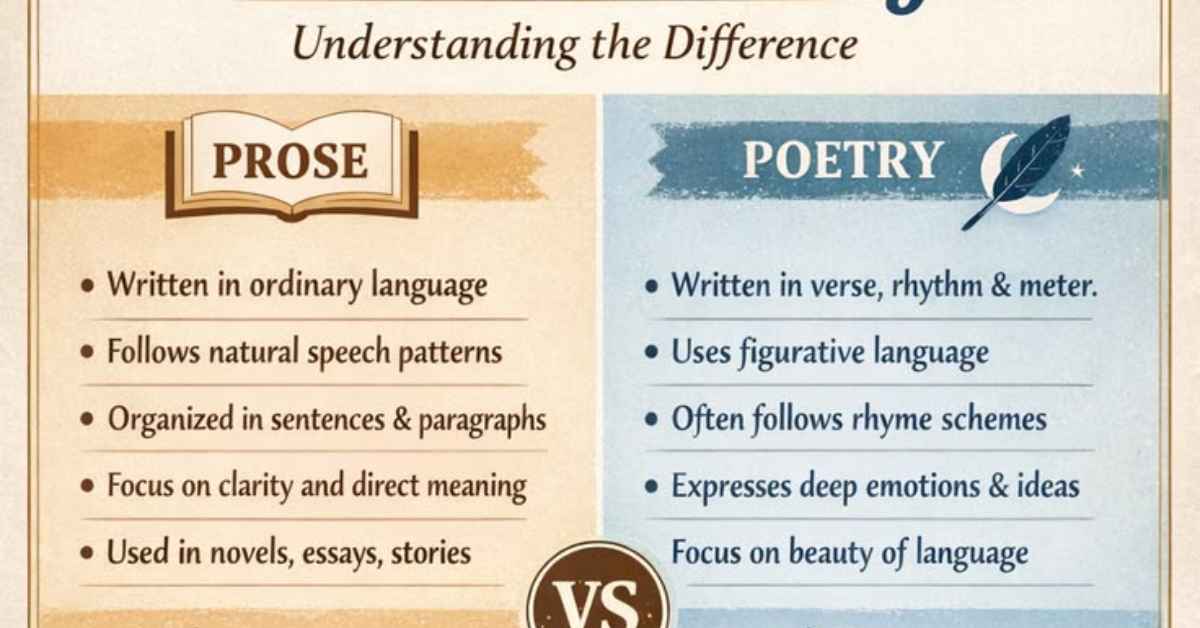
Prose and poetry are two beautiful ways to share stories, ideas, and feelings. Prose sounds like everyday talking, while poetry feels like music made from words. Once you know how they differ, reading and writing both become more fun. The five poems below will help you feel that difference yourself.
Difference Between Prose and Poetry
Two Roads of Words
Prose is a road that runs straight and wide,
Sentence by sentence, it walks you inside.
Poetry is a path that bends through the trees,
It hums to the rhythm of the wind and the breeze.
One tells the story the way people talk,
One dances in lines on a slow, quiet walk.
Both reach the heart at the end of the day,
Each in its own special way.
Meaning of the Poem
This poem compares prose and poetry to two different roads. Prose moves in a straight line, like a person telling a story. Poetry bends and dances, using rhythm and short lines to share feelings. Both roads lead to the same place, which is the reader’s heart.
Grandma’s Kitchen Story
Grandma sat in the kitchen after dinner
and began to talk.
She told me about the summer it rained for a week,
the bread she baked on cold mornings,
and the neighbor who left flowers at her door.
She never used a rhyme or a special beat.
She only told the truth, one sentence after another,
and I remembered every word.
Meaning of the Poem
This poem shows how storytelling in prose can be simple and full of feeling. Grandma speaks in plain sentences, with no rhyme or musical beat. Her honest words make every memory feel real to the listener. The poem reminds us that plain words can carry deep love.
Rain on the Window
Tap, tap, tap on the window pane,
Little silver drops of rain.
The sky is singing a lullaby,
And clouds are quilts drifting by.
My worries slip down with every drop,
Then quietly, quietly, they all stop.
Rain, you are music I cannot hold,
A gentle poem, quiet and old.
Meaning of the Poem
This poem uses sound and picture words to describe falling rain. The rhythm feels like tapping, which makes the reader hear the storm. The rain also washes away the speaker’s worries and leaves a calm feeling behind. It shows how poetry turns a simple moment into music.
Same Feeling, Two Ways
I wrote my friend a letter, long and plain,
About the days, the laughter, and the rain.
Then wrote it once more in a few short lines,
An empty chair, where the sunlight shines.
The first used many words, the next used few,
Yet both were carrying a heart to you.
One built a bridge, one left a single door,
Both said the same thing: I miss you more.
Meaning of the Poem
This poem shows one feeling written in two different ways. The letter uses many plain words, while the short lines use fewer. Both forms carry the same message of missing a friend. It teaches that prose and poetry share feelings, even when they look different.
Where the Lines Melt
There is a place where the two meet,
Where sentences stroll but the music is sweet.
No rules for the lines, no need for a rhyme,
Just pictures and feelings that dance through time.
A prose poem is a small, bright door,
Between the stories and the songs we adore.
It looks like a paragraph, quiet and plain,
Yet hums like a song when you read it again.
Meaning of the Poem
This poem describes the prose poem, a form that sits between prose and poetry. It looks like a paragraph but sounds like a soft song. There are no strict rules about line breaks, rhyme, or length. The poem invites readers to enjoy both styles together, without choosing one.

Prose and Poetry Meaning in Simple Words
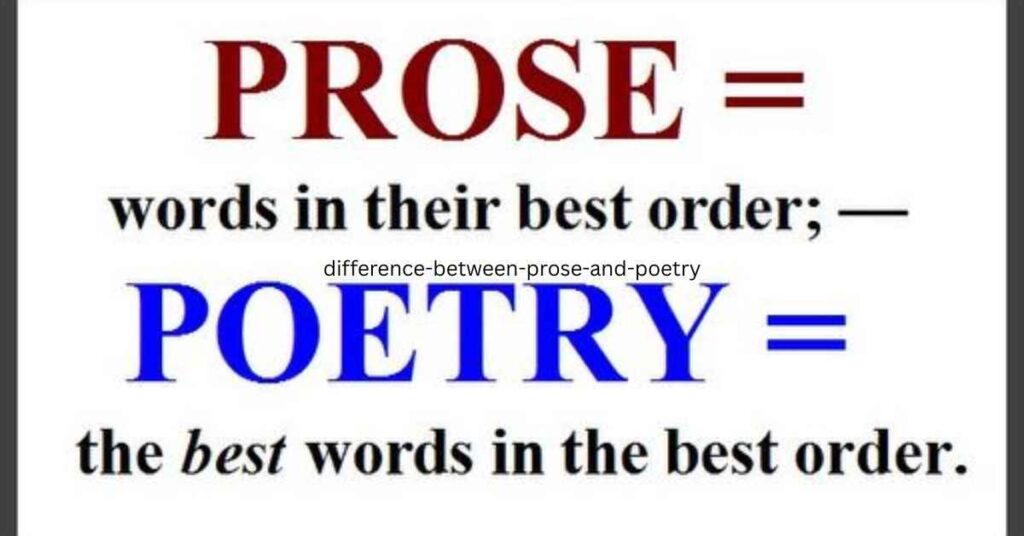
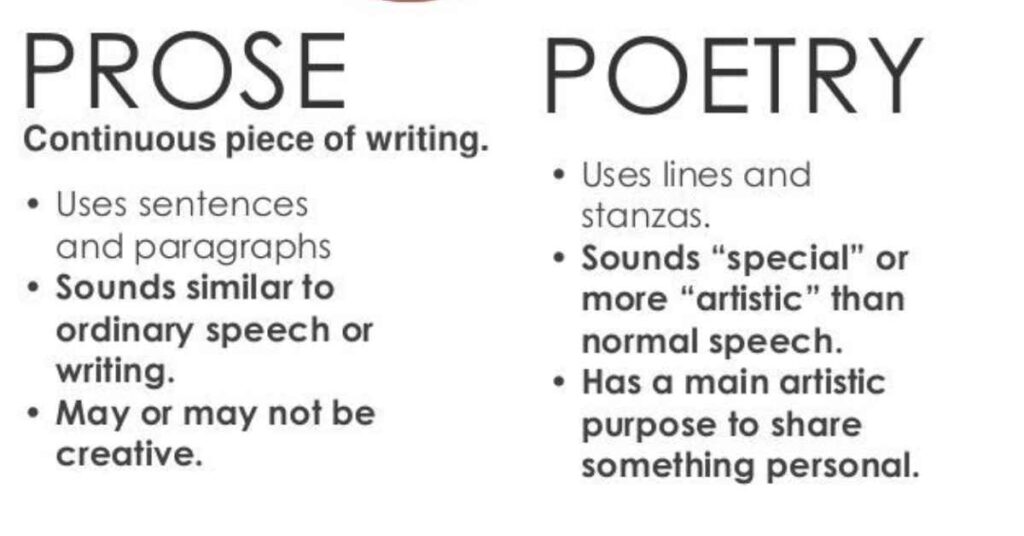
To understand prose and poetry, start with the way each one sounds. Prose is the language we use every day. When you talk to a friend, write a message, or read a story, you are using prose. It is made of sentences and paragraphs, and it moves forward in a clear, natural way.
Poetry is a more musical and compact way of using words. Instead of paragraphs, it uses lines and stanzas, which are small groups of lines. A poet picks each word with care, thinking about sound, rhythm, and the pictures the words create. A few lines of poetry can hold as much feeling as a full page of prose.
So the meaning of prose and poetry is simple. One is made for clear, flowing communication. The other is made for feeling, sound, and imagination.
10 Differences Between Prose and Poetry
Here are ten clear differences, explained one by one, so you can spot them whenever you read.
The first difference is structure. Prose is written in sentences that sit together in paragraphs. Poetry is arranged in lines and stanzas, like small steps on a staircase.
The second difference is where a line ends. In prose, the edge of the page decides when a line stops. In poetry, the poet decides, and each break tells the reader where to pause.
The third difference is rhythm. Prose follows the natural rhythm of speech, the way people talk. Poetry often has a chosen beat, so the words feel almost like music when read aloud.
The fourth difference is rhyme. Prose rarely uses rhyme, because it can sound strange in a story or an article. Poetry often uses rhyme, although free verse, which has no rhyme, is also very popular.
The fifth difference is length. Prose has plenty of room to explain and describe. Poetry uses fewer words, so every word has to matter.
The sixth difference is the kind of language. Prose usually says things directly, so the reader can follow easily. Poetry loves comparisons and pictures, such as calling clouds quilts or rain a song.
The seventh difference is purpose. Prose is mostly used to tell a story, explain an idea, or share news. Poetry is mostly used to express a feeling or capture a single moment.
The eighth difference is reading speed. Prose is often read quickly to follow the story. Poetry invites you to slow down, read again, and stay with the words.
The ninth difference is meaning. Prose usually has one clear message that most readers understand in the same way. Poetry can hold many meanings, and each reader may find something different in it.
The tenth difference is the forms each one takes. Prose appears in novels, short stories, essays, letters, and news reports. Poetry appears in forms like haiku, sonnets, ballads, and limericks.

Are Prose and Poetry the Same?
No, prose and poetry are not the same, but they are close relatives. They use the same words and the same language, yet they arrange those words in different ways and for different reasons. Prose puts sentences into paragraphs to explain or tell. Poetry shapes lines and sounds to make you feel something.
Some writing sits between the two, like the prose poem in our last poem, so the answer is not always black and white. You can think of them as two rooms in the same house. They look different inside, but they share the same walls.
Similarities Between Prose and Poetry
Even with all these differences, prose and poetry have a lot in common. Both are made of words, and both are used to share ideas, memories, and emotions. A great novel can make you cry, and so can a short poem.
Both also depend on imagination. A prose writer might describe a stormy night so well that you can almost hear the thunder. A poet might do the same thing in six short lines. Both use strong pictures and careful word choices to help the reader see and feel.
Both can also tell stories. A story poem can carry a whole adventure, and some prose is so beautiful that it sounds like a song. The line between them is not a strong wall. It is more like a soft border, and writers cross it back and forth all the time.
Prose and Poetry Examples
Prose is all around you. A fairy tale before bedtime is prose. So is a novel like Alice’s Adventures in Wonderland, a newspaper report, a school essay, a diary page, or a speech. Whenever words run in sentences and paragraphs, you are reading prose.
Poetry is just as close to your daily life. A nursery rhyme is poetry, and so is a haiku about a frog by a pond. A famous example is “I Wandered Lonely as a Cloud” by William Wordsworth. In Urdu, the verses of Allama Iqbal and Mirza Ghalib are also loved examples of poetry.
Prose poems are rarer, but they exist too. Charles Baudelaire wrote a well-known collection of them called Paris Spleen. They look like short paragraphs, yet they use the images and music of poetry.
How to Read Prose and Poetry
Reading prose and poetry needs slightly different habits. With prose, you usually read at a steady pace and follow the story or idea from one sentence to the next. If something is unclear, going back a paragraph usually helps.
With poetry, it helps to slow down. Read the poem once to get the general feeling, then read it again out loud. Listen to the rhythm and notice which words stand out. Pay attention to the pictures the poet paints, because poems often say more through images than through direct statements.
It is also fine if a poem does not make complete sense on the first try. Poetry does not always give one fixed answer. You can ask yourself how the poem makes you feel and what it reminds you of. Your own experience is part of how a poem comes alive.
Prose and Poetry in English
In English classes, prose and poetry are studied as two main branches of literature. Prose includes novels, short stories, essays, and letters, all written in ordinary sentences. Poetry includes poems of every size, from a tiny four-line rhyme to a long epic. Students read prose to follow the plot, the characters, and the message, and they read poetry to enjoy the sound, the pictures, and the hidden meanings. Learning both also grows your vocabulary, because prose shows how words work together in sentences, while poetry shows how one small word can carry a big feeling.
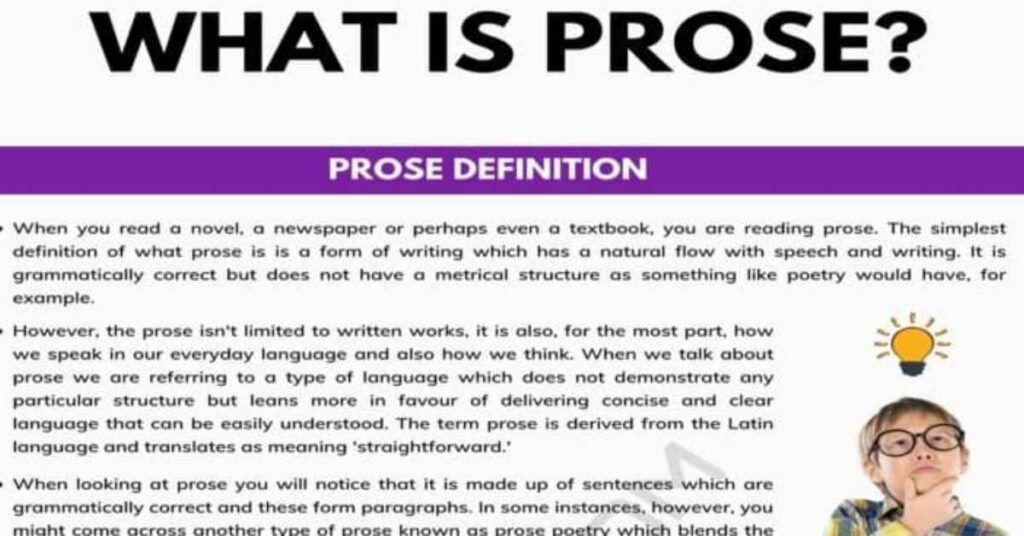
Prose and Poetry Books and PDF Notes
Many schools teach prose and poetry together, so you will often find them in the same English book. A typical prose and poetry book has short stories, essays, and speeches in one part, and poems in another. This makes it easy to compare the two forms side by side.
Some students also keep PDF notes for quick revision. These are helpful for remembering meanings and definitions, but try to read the original stories and poems too, because that is where the real feeling lives.
A simple exercise can teach you a lot. Pick one prose passage and one poem on the same theme, such as nature, friendship, or family. Notice how the prose explains and how the poem suggests. That small comparison teaches more than memorizing a list of definitions.
FAQs
What is poetry and prose?
Poetry is a kind of writing that uses lines, rhythm, and carefully chosen words to share feelings and pictures. It often uses rhyme or repeated sounds to make the words feel like music. Prose is ordinary writing in sentences and paragraphs, like the words in stories, letters, and news. Together, prose and poetry are the two main ways people write.
What are 5 examples of prose?
Five common examples of prose are novels, short stories, essays, newspaper articles, and biographies. A biography is a true story about a person’s life. Letters, speeches, and school textbooks are also written in prose. Any writing made of normal sentences and paragraphs is usually prose.
What are 10 types of poems?
Ten popular types of poems are the haiku, limerick, sonnet, ballad, ode, elegy, epic, acrostic, free verse, and story poem. A haiku is a tiny three-line poem, often about nature. A limerick is a funny five-line poem with a bouncy rhyme, and a sonnet has fourteen lines. A ballad tells a story in song-like verses, an ode praises something, and an elegy remembers someone who has passed away. An epic is a very long poem about heroes, and an acrostic is a poem where the first letters of each line spell a word. Free verse has no fixed rhyme or pattern, and a story poem simply tells a story in poetic lines.
What is meant by prose poetry?
Prose poetry is writing that looks like a paragraph but uses the beauty of poetry. It has no line breaks and usually no fixed rhyme, yet it still uses strong images, rhythm, and emotion. It sits between prose and poetry, which is why many readers find it fresh and interesting.

Hafiz Muhammad Shakir is the founder of USACaption.com, an SEO Specialist and Web Developer passionate about creating original poetry, shayari, captions, and user-focused content.